Wednesday, 8 May 2013

Thursday, 21 March 2013
Tea Plantation Workers (Tea Pickers)
By Grace Guria - EWIF
The
Tea Plantation Industry is an important Agro based industry in India.
Assam occupies the top position in the production of tea as about 52%
crop is produced in this state and its contribution to national
exchequer as foreign exchange earner is about 60% of the total
exchange. About 8 lac workers are directly employed in this industry.
The number could still be higher. Thus tea industry occupies the
position of a premier industry as an employer of large labor force.
India is the biggest producer, consumer and the biggest exporters of
tea in the world, followed by China, Sri Lanka, Kenya, Indonesia,
Russia, Bangladesh and a sizable number of small and big nations of
the world who have come to the scene of tea production.
Tea
gardens are a highly labour intensive industry, providing year-round
employment. They provide livelihood to the scheduled castes and
scheduled tribes, in regions that are generally less developed.
Those
employed have a low grade of existence and are not able to take up
responsibility for their own life, due to social circumstances,
regional disparity, and political situation, lack of Education and
absence of strong organized group.
The
booming tea industry of Assam thrives on the hard work and sweat of
the Tribal Migrants who are at work since the first half of the 19th
century. The `Adivasis' are one of the most marginalized sections of
the society in India particularly in Assam. In fact they were
brought through allurements and false promises.
Even
to this day the tea pickers are socially unaccepted and unwelcome in
the land where they have been working for more than a century. Their
lives can be described simply as mere existence and survival in a
system of controlled injustice from the very beginning and a denial
of basic needs necessary for human existence.
Problems
relating to maternal and child health, gastrointestinal problems, diarrhoea, blood pressure among women and Tuberculosis are of high
prevalence among the tea plantation labourers. The community as a whole
faces shocking biological misfortune of chronic malnutrition
In
order to bring up the health & quality of life of the tea
pickers, what is essential is
- Clean drinking water – through partnerships with technology and equipment providers
- Hospitals – availability and management
- Schools - availability and management
We
at EWIF propose to address this because their needs are not heard,
ignorance dominates, there is no perspective as how to begin developing &
utilizing available resources & facilities leading to a better
life for the tea pickers.
We
propose to work on this by:
- Strategies and planning
- Develop a stakeholder commitment
- Information fliers
- Funding & cash flow management
- Constant monitoring & reviews
To
tap the human Resource, we will approach the college students of the
West and the North East to participate and work with tea pickers in
North Eastern villages.
- Study the tea pickers views
- Make them pro-actively involved, authorized and responsible
- Train them, direct them, and support them to start with
- Development of marketing & distribution for handicrafts and Agro products
The
value proposition to sponsors and beneficiaries will be seen
in a way the projects are materialized. We invite them to connect with us.
- The North Easterners will develop their entrepreneurship & business skills
- Organization Development - Self help groups, team work and co-operation
- Development of healthy future generations
- Prosperity of the people through adoption of livelihood of their choice
- Time well spent and the development of a peaceful & prosperous existence
See BBC Video of September 2015
Friday, 15 March 2013
Problems of Agricultural Labor in India and Solutions
Presentation
by Juliana Chakungliu NK - EWIF
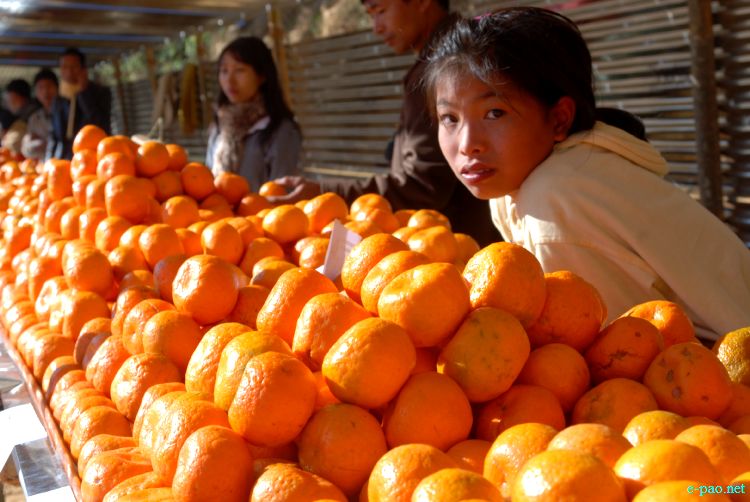
(Oranges in Tamenglong, Manipur)
- Define Agricultural Labor
- An agricultural laborer is a person hired to work in the agricultural industry.
- This includes work on farms of all sizes, from small, family-run businesses to large industrial agriculture operations.
- The farmworker may or may not be related to the individuals who own or run the farm, but his or her job entails a more formal relationship than a family member or neighbor who might do occasional chores on the farm.
- Depending on the location and type of farm, the work may be seasonal or permanent.
- Seasonal, or migrant workers, are often low-wage workers, who may or may not be working in their region of origin.
- Permanent workers may have a particular set of skills or educational background that allow them to earn higher wages, and are often found on farms where there is year-round production, such as on dairy farms.
- Farmworkers usually earn a wage; however, the work can be done on a volunteer basis or for educational reasons.
- Many programs exist that facilitates the placement of volunteer farmworkers on specific types of farms.
- Additionally, farms may offer apprenticeship or internship opportunities where labor is traded for the knowledge and experience gained from a particular type of production.
- Agriculture in India
- Today, India ranks second worldwide in farm output. Agriculture and allied sectors like forestry and fisheries accounted for 16.6% of the GDP in 2009, about 50% of the total workforce. The economic contribution of agriculture to India's GDP is steadily declining with the country's broad-based economic growth. Still, agriculture is demographically the broadest economic sector and plays a significant role in the overall socio-economic fabric of India.
- India's agricultural economy is undergoing structural changes. Between 1970 and 2011, the GDP share of agriculture has fallen from 43 to 16 percent. This isn't because of reduced importance of agriculture, or a consequence of agricultural policy. This is largely because of the rapid economic growth in services, industrial output, and non-agricultural sectors in India between 2000 to 2010.
- Problems faced by Agricultural Labor in India
- Excess Supply – there are no accurate estimates of work forces as most of the activity and persons involved is unorganized and unreported. However the number of persons to work on and feed off a holding is very high.
- Seasonal Employment – varying weather patterns – drought, floods, heat cold cause an unreliable productivity.
- Backward classes SC ST – farmers usually come from a less privileged class and hence are mostly un-educated and do not have benefits of respect of the society.
- Small farm land holdings – which result in a lack of economies of scale.
- Limited subsidiary occupation – alternate revenue streams from other activities are not available to farmers.
- Heterogeneous – issues and problems have regional variations.
- Migration to other occupations – the more educated and efficient work forces are migrating to other forms of employment, leaving weaker work forces in the agricultural profession.
- Indebtedness – money is borrowed from exploitative private money lenders. Borrowings spiral and the ability to pay back is limited. There is a need for agro finance, micro-finance, cooperative banking and financial products to suit farmers needs and longer term payback schedules.
- Solutions
- Effective implementation of the minimum wage act – this would go a long way in the development of quality work forces in agriculture in India.
- Development of Agriculture - multi-cropping – for better utilization of land and resources
- Subsidiary revenue streams - Alternative employment opportunities - rural village infrastructure, rural industry, food processing, agro tourism, and outdoor sports (golf as in Thailand - farmers + golf caddies)
- Formation of peasant unions – to combat problems such as those which loan sharks create
- Cooperatives / Self Help Groups (SHG) – for better technology, training, funding, marketing and economies of scale
- Debt management – financial products and services and advice for farmers
- Recast of ownership – property laws and holding patterns with a better quality of ownership registration & records
- Development of cattle wealth – more productive cattle – yielding more milk per day
- Irrigation development – water problems are immense and better water management by superior irrigation, drip irrigation and so on will help
- Marketing & distribution – middlemen eat away a farmer’s profits. Cooperative and rural markets would help to bring the farmer closer to the end consumer thus eliminating agent commissions, which are very large.
- Organized work force – better training, coordination and managed work forces for efficiency.
- Agricultural insurance – in event of natural problems, floods, drought, firs, pest problems etc. insurance would help the farmers survive.
- Entrepreneurship development – coach farmers to become entrepreneurs. An entrepreneur is the best possible strategist.
(Juliana is a first year MA student in Economics at Pune College. She made this presentation at the college on 15.03.13. She is a Naga from the Tamenglong District of Manipur and works on North East Development work from our Pune Office. She can be contacted at pune@eastwestinterconnect.org.in)
Thursday, 31 January 2013

Monday, 21 January 2013
Indian winner Binning Lyngkhoi to use prize money to treat ailing father
Indian winner Binning Lyngkhoi to use prize money to treat ailing father

Lyngkhoi Binning may not be happy as far as his timing is concerned, but he was nevertheless delighted with his win yesterday. The USD 6,500 (approximately Rs 4 lakh) will help him treat his father, who is suffering from tuberculosis.
Defending champion Binning clocked 2:21:16 to emerge the fastest Indian among the men's full marathoners in the eighth edition of the Mumbai Marathon yesterday. Angad Kumar (2:24:32) and Ram Singh Yadav (2:25:33) finished second and third respectively.
Binning, who hails from a small village in Meghalaya, said he desperately needed the money for his father's treatment.
"We were taking some temporary treatment, but doctors had advised us to take him to a specialised hospital as his illness is quite severe now.
"There is no proper medical facility where I live. To provide better treatment, I have to bring him to a city hospital. But I didn't have enough money for that. Thankfully, after this win, I can immediately start my father's treatment. I will speak to the doctor now and get my father admitted in a good hospital rightaway, probably in Bangalore or Mumbai because these two cities have some of the finest medical facilities," Binning told MiD DAY.
Binning wanted to collect the money himself and so never sought any help from his employers, the Indian Army.
"I wanted to do as much as I could for my father. I was confident of doing well in the Mumbai race, so I didn't ask anyone for help," he said.
Though, Binning was yet to talk to his father about his win, his brother heaved a sigh of relief when he learnt of the victory.
"He was relieved when I told him that I won. He said was: 'ab pitaji ka ilaaj achche se kar paayenge' (We can now give a better treatment for our father)," Binning signed off.

Lyngkhoi Binning may not be happy as far as his timing is concerned, but he was nevertheless delighted with his win yesterday. The USD 6,500 (approximately Rs 4 lakh) will help him treat his father, who is suffering from tuberculosis.
Defending champion Binning clocked 2:21:16 to emerge the fastest Indian among the men's full marathoners in the eighth edition of the Mumbai Marathon yesterday. Angad Kumar (2:24:32) and Ram Singh Yadav (2:25:33) finished second and third respectively.
Binning, who hails from a small village in Meghalaya, said he desperately needed the money for his father's treatment.
"We were taking some temporary treatment, but doctors had advised us to take him to a specialised hospital as his illness is quite severe now.
"There is no proper medical facility where I live. To provide better treatment, I have to bring him to a city hospital. But I didn't have enough money for that. Thankfully, after this win, I can immediately start my father's treatment. I will speak to the doctor now and get my father admitted in a good hospital rightaway, probably in Bangalore or Mumbai because these two cities have some of the finest medical facilities," Binning told MiD DAY.
Binning wanted to collect the money himself and so never sought any help from his employers, the Indian Army.
"I wanted to do as much as I could for my father. I was confident of doing well in the Mumbai race, so I didn't ask anyone for help," he said.
Though, Binning was yet to talk to his father about his win, his brother heaved a sigh of relief when he learnt of the victory.
"He was relieved when I told him that I won. He said was: 'ab pitaji ka ilaaj achche se kar paayenge' (We can now give a better treatment for our father)," Binning signed off.
Friday, 4 January 2013
8th North East Business Summit

Dear friends from North East India
A very happy new year 2013 to you!
As a veteran of the North East Business Summits run by the Indian Chambers of Commerce (ICC) of Kolkata, I will be attending the 8th North East Summit in New Delhi on January 9th & 10th at the Le Meridian. This will be the 6th summit I would have attended since 2003. The details are online at http://bit.ly/8thnebs
I have recently promoted the EWI Development Initiative Foundation (aka. East West Interconnect, website at www.eastwestinterconnect.org.in) as a Sec. 25 Company, not for profit. The purpose is to assist in bridging the Western India Region (mainly Maharashtra & Gujarat) with the 8 North East States in a manner to contribute to North East Development. The activity focus would be on Entrepreneurship Development as I do believe that it is only when North East Entrepreneurs match their counterparts in the rest of the country, will true prosperity be created in the North East. Partnering with Western India Enterprises and Investors would be an asset for North East Entrepreneurs. To better understand the North East Region, advocacy for and about the region is required in Western India.
The sectoral focus includes:
1) Hospitality – 3 & 4 star hotels, Motels, Resorts, Heritage Properties, MICE & restaurants
2) Hospitals & Wellness – Small hospitals (25-50 rooms) and clinics, SPAs and fitness centers
3) Sports – Infrastructure and facilities (grounds, stadiums, courts, golf courses etc.) training – private and public
4) ITaS – IT as a service – Hosted Solutions for SMEs – cloud computing, virtualisation and open source development
5) HRD – Education – coaching & training for the above sectors
6) Environment
a) Water Management
b) Waste Management
7) Townships & Rurbanisation, including rurban market areas
8) Power Infrastructure - Hydro & Thermal Power, Solar Power
9) SME's in
a) Agro - bamboo, agriculture, horticulture, sericulture
b) Animal husbandry - pigs & cattle
c) Poultry
d) Fish farming
e) Apiaries
f) Manufacturing
g) Handicrafts
My team and I would take up such projects on a turn key basis covering - market studies, product/service positioning, feasibility, business strategies & plans, identification and negotiation with service partners (HMCs etc.) identification and negotiation with debt and equity investors and related documentation. East West Interconnect would address Entrepreneurship Development - HRD – Education – coaching & training for the above sectors. Our consulting arm, Advanced Strategies Pvt. Ltd. would assist with commercial project inputs. Bee Management Consultancy Pvt. Ltd. would assist in bringing in overseas participation, as the project may require. If you wish to be a sponsor of East West Interconnect, I would be pleased to discuss your participation & involvement.
I would be happy to meet you in New Delhi on January 9th & 10th at the Le Meridian and discuss your requirements, based on which a proposal would be provided to you later. Please note that Advanced Strategies Pvt. Ltd. which would assist with commercial project inputs charges fees customized to suit project requirements.
My assistants Ms. Vinika Kasar & Ms. Hiral Shah are available in Mumbai at 022-22672561 and emails to info@astrategies.com would reach them and me.
So if you own property, have some start up funds to invest and a zest to develop your entrepreneurship prowess, lets go together.
yours truly,
for East West Interconnect
Rajiv Bhatia
Promoter & Principal Mentor
Saturday, 22 December 2012

Subscribe to:
Posts (Atom)